
What is “Punctum”?
...and who cares about Latin anyway!

A photographer I knew in Washington showed his new masterpiece to two friends. The first friend said,, "Wow, what a powerful statement on industrialization and its impact on the rural landscape. The lighting is superb." The second friend squinted and said, "Wait... is that a single, devilish chicken nugget on the ground in the corner?" The photographer grabbed the second friend by the shoulders and yelled, "YOU SAW IT! YOU REALLY SAW IT!"
Whether he did that to overstate a point or was just being nasty, this event nonetheless showed that in photography what may seem unimportant to some viewers is actually vital to another, and that’s why I thought the chicken nugget was why he made the photograph.
I never quite got Roland Barthes' point about intense image making until I watched that gallery display unfold. In the vast universe of images we consume daily, some photographs are merely seen, while others arrest us, lodge themselves in our memory, and refuse to let go. They possess a strange power, an emotional resonance that transcends their subject matter.
Barthes, a French literary theorist, in his profound and deeply personal 1980 book Camera Lucida, gave us a vocabulary to understand this phenomenon. He proposed two distinct ways of experiencing a photograph: through its Studium and its Punctum. For any photographer aspiring to create work with genuine energy, drive, intention, and power, understanding this distinction is not merely an academic exercise; it is the key to unlocking the very soul of the medium.
The Studium is the photograph’s general, cultural, and intellectual content. It is the “what” of the image—the information it conveys, the context we understand, the intention of the photographer that we can readily decipher. It operates on the level of shared meaning. When we look at a photo of a political rally, the Studium is our understanding of protest, the signs, the collective purpose. When we see a classic family portrait, the Studium is the recognizable convention of family, unity, and a moment preserved. It is a polite interest, an intellectual appreciation. A photograph with strong Studium is competent, like this one of doctors with a patient, is well-composed, and informative.

We look at it, we say, “I get it,” and we move on. It satisfies our curiosity but rarely touches our heart.
The Punctum, however, is something else entirely. Barthes described it as a sting, a prick, a wound. It is an often-unintentional detail within the photograph that pierces the viewer (chicken nuggets?), rising from the scene and shooting out of it “like an arrow.” It is intensely personal and subjective. The Punctum is not what the photographer meant to show you; it is a detail that finds you ... .that's why it doesn’t matter if the photographer in my story was being nasty or joking.
Punctum could be the worn strap on a woman’s shoe, a chipped fingernail, the awkward angle of a subject’s hand, or a look in someone’s eyes that seems to break the fourth wall and acknowledge you, the viewer, across time and space. For Barthes, the ultimate Punctum was found in the “Winter Garden Photograph” of his recently deceased mother as a young girl; it wasn’t the overall image but a specific detail—the gentle bearing, the character in her eyes—that allowed him to truly find his mother, a truth unavailable in any other picture.
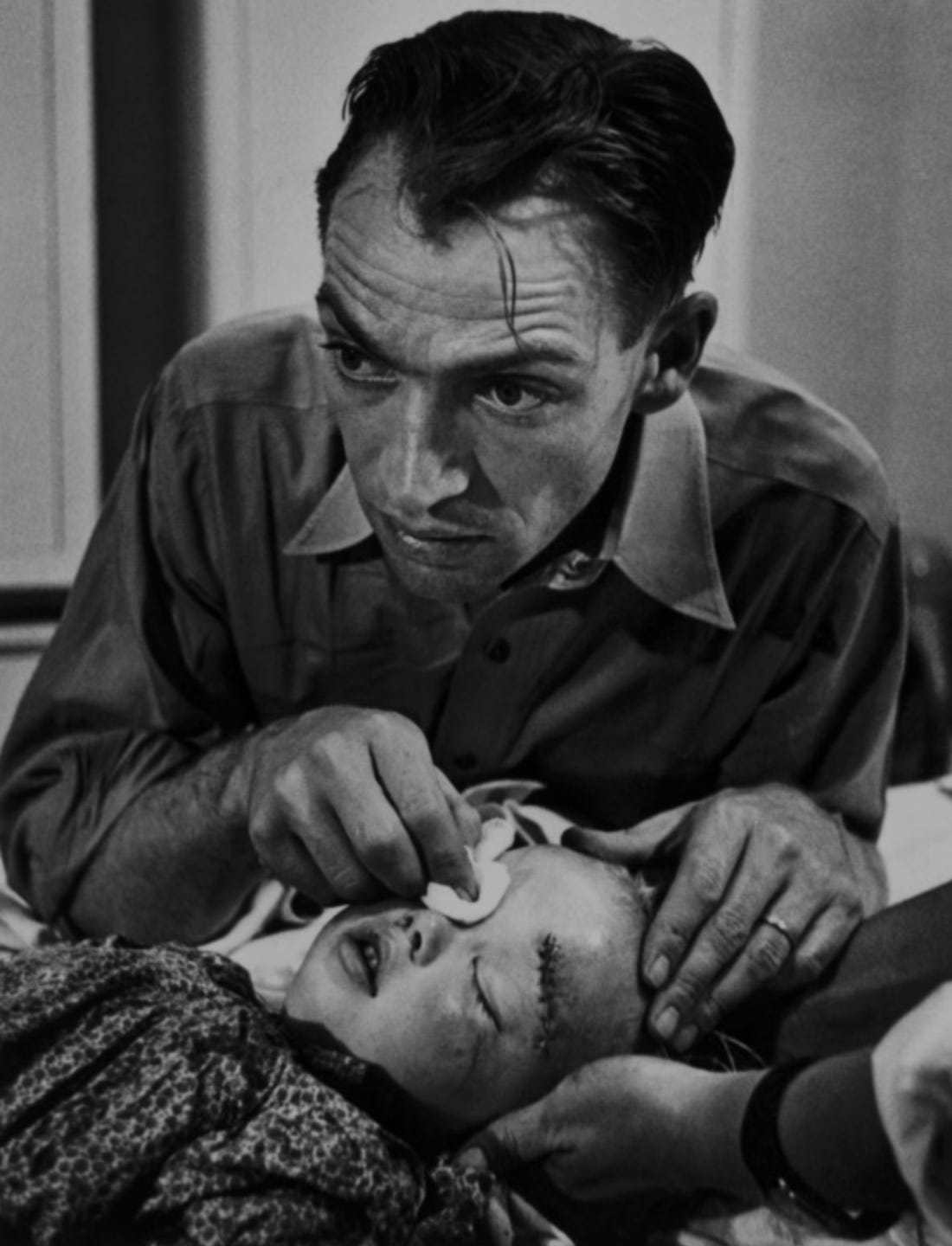
W. Eugene Smith, one of the great champions of storytelling with photographs, made the above photograph of a “Country Doctor,” when on assignment for Life Magazine. What a difference punctum makes! The Punctum bypasses the intellect and strikes at the core of our being. It is the element that makes a photograph unforgettable, because it establishes a direct, visceral, and private connection ... .it's not just a doctor seeing a patient, its a doctor healing.
So why is this critical for the ambitious photographer? Because while the world is saturated with images of competent Studium, it is starved for the power of the Punctum. To create a photograph that endures, that becomes a legacy piece, one must learn to hunt for the conditions that allow a Punctum to emerge.
A photographer who only focuses on Studium is a technician. They master composition, lighting, and subject. They create images that are clear and communicable, but often sterile. Their intention is to show something. The photographer who strives for Punctum, however, is an artist. Their intention shifts from merely showing to creating an environment where something might be felt. This requires a radical form of presence and observation.
It means looking past the main event to the periphery. It’s not just capturing the bride and groom kissing (Studium); it’s noticing the single tear rolling down the father’s cheek in the background (Punctum). It’s not just photographing the triumphant athlete crossing the finish line (Studium); it’s capturing the frayed, muddy shoelace that speaks of the grueling journey (Punctum). This is the paradox: while Barthes argues the Punctum is found by the viewer and often accidental, the photographer can intentionally create the space for these accidents to happen. This is done by cultivating empathy, by looking for the small, unguarded truths that betray the larger, constructed reality of the scene. It is the pursuit of the authentic detail that has the potential to wound a future viewer with its truth.
From the moment I saw that image, I have not been able to erase the sight of country Dr. Ernest Ceriani’s right index finger on the cotton ball swabbing away what must surely be the tears of a hurt child. That’s punctum for me.
The important, legacy photographs are almost always defined by their Punctum. Think of Dorothea Lange’s "Migrant Mother." The Studium is the Great Depression, poverty, and maternal worry. But the photograph’s enduring power comes from its details: the way her fingers press against her cheek, the worried furrow of her brow, the children burying their faces in her shoulders. These elements are the Punctum—they are what carry the emotional weight of an entire era into our present moment. [NOTE: Stay tuned for a revealing Substack I’ll write in a few week’s about what Lange seems to have gotten away with.]
Therefore, for the photographer who wants their work to have energy and drive, the goal is to weave the potential for Punctum into the fabric of a strong Studium. You need the craft of Studium as a foundation, but you must infuse it with the soul-seeking of Punctum. It is the difference between an image that is seen and an image that is felt—and for the photographer seeking to create a legacy, that is all the difference in the world.
So well said …and your words triggered a flood of photo images from the past. I had never thought or knew of the distinction …but so true. One photo that came to mind was of that poor, naked, napalmed Vietnamese girl … to bring home the horrors of war. Keep writing and photographing!
Mike